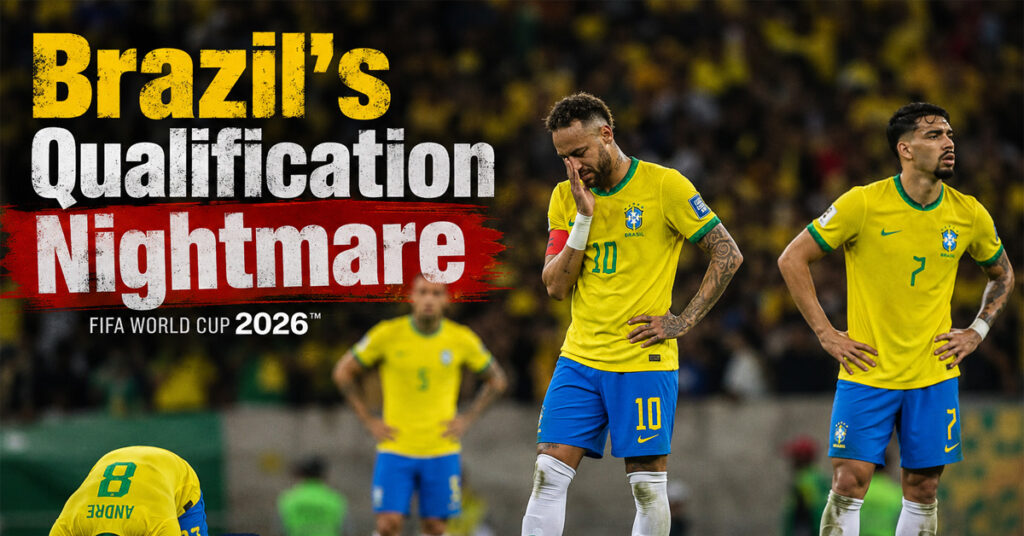
Brazil’s Qualification Nightmare: Why the ‘Four-Point Rule’ No Longer Saves Them
Brazil’s 1-1 draw against Morocco at MetLife Stadium in New York/New Jersey has triggered an unexpected qualification crisis. Projections from our qualifier model suggest that Brazil’s probability of advancing to the Round of 32 has plummeted from 94% pre-match to roughly 68% following the result.
For a team that has historically navigated group stages with clinical efficiency, the reality is now jarring: the “four-point safety net” that has defined World Cup qualification for decades no longer guarantees survival in the expanded 48-team format.
Group C Standings (As of June 18)
| Team | Played | Pts | GD |
|---|---|---|---|
| [Team A] | 2 | 4 | +2 |
| Brazil | 2 | 2 | 0 |
| [Team B] | 2 | 2 | -1 |
| [Team C] | 2 | 1 | -1 |
The “Four-Point” Myth in a 48-Team World
In previous tournaments, four points were the golden ticket. It was the standard threshold for safety, an almost guaranteed pass into the knockout stage. In this expanded 48-team bracket, those old rules have been rendered obsolete.
With 12 groups of four, the structure of the tournament has fundamentally shifted. The primary goal is no longer just finishing in the top two of your group; it is surviving the global scramble for the eight “best third-place” spots. Unlike the old system, where you only needed to outperform the three teams in your immediate group, you now have to look over your shoulder at 11 other groups.
This creates a “global table” where goal difference, total goals scored, and even disciplinary records (the dreaded “fair play” points) become the ultimate arbiters. A single 90th-minute goal in a match thousands of miles away can be the difference between a team reaching the Round of 32 or heading to the airport.
The Complexity of the Wildcard Race
The third-place table has become a chaotic environment where the margin for error is razor-thin. Teams finishing on three points, which would have felt relatively secure in a 32-team format, are now effectively forced to wait and see.
Because teams play at different times across multiple time zones, the “cutoff line” for the eight wildcard spots is a moving target. Fans tracking the standings are essentially managing a real-time, global permutation problem. If Brazil finishes on three points, they are not just relying on their own performance; they are relying on specific, often unlikely results in Groups F and H to avoid elimination. The tournament has essentially created a “second bracket” that exists entirely outside of the initial group stage play.
What This Means for Brazil
Brazil now enters the final matchday with significantly less margin for error. Based on current tournament projections, the path forward is much narrower than it was 48 hours ago:
| Matchday 3 Result | Projected Advancement Probability |
|---|---|
| Win | ~95% |
| Draw | ~37% |
| Loss | < 5% |
If Brazil draws their final match to finish on three points, they are not just hoping for a favorable outcome; they are effectively forced to rely on the results of other groups to keep their tournament hopes alive. A loss would almost certainly result in immediate elimination, marking a historic and disappointing early exit for a tournament favorite.
The Tactical and Psychological Burden
Carlo Ancelotti noted in the post-match conference that the team is now in a position where they no longer fully control their own destiny. This lack of control changes the tactical approach entirely. Does a team play for a draw to secure three points, or do they gamble on an aggressive win, potentially exposing themselves to a counter-attack that could ruin their goal difference?
Furthermore, there is the “Annex C” factor – a complex lookup table designed to prevent teams from the same group from meeting again in the Round of 32. This means even if Brazil qualifies, they cannot yet know their potential opponent, adding another layer of uncertainty to an already volatile situation.
Using Technology to Track the Chaos
The sheer volume of potential permutations in this 12-group format is overwhelming for even the most seasoned analysts. We have developed a FIFA World Cup 2026 Group Stage Qualifier Calculator that allows users to input potential scorelines to see exactly how the third-place table shifts in real-time.
It provides a clearer view of the math involved as the final group games unfold. Whether you are tracking the “wildcard” race or trying to determine who your team might face in the Round of 32, the calculator handles the complex sorting logic that is currently dominating the post-match discourse.
Stay tuned to our live feed for updates on Group C and the final standings as the matchday concludes.
Quality & Expertise Assurance

Sam
With 20+ years in banking, insurance and energy sector, Sam has worked with US and Canadian firms. He combines deep industry expertise with strong web development skills, offering practical insights that bridge finance and technology.