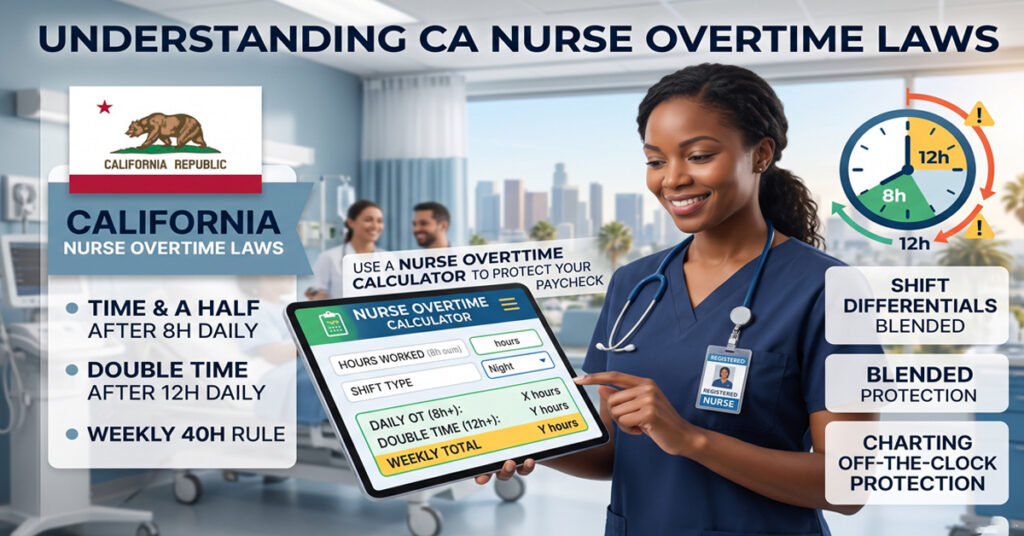
California Nurse Overtime Laws: Daily Overtime, Double Time, and the Rules Hospitals Rarely Explain
- Key takeaways
- California counts overtime one day at a time
- Twelve hours is the real cliff edge
- The 8/80 loophole that doesn't survive the state line
- Three 12-hour shifts and the alternative workweek vote
- Your regular rate is bigger than your base pay
- Mandatory overtime has a narrow emergency exception
- On-call pay and driving between sites
- A missed meal break costs more than people think
- Travel nurses, per diem staff, and agency math
- Working two units, two pay rates, one overtime calculation
- Split shifts and the charting-after-clock-out problem
- A salary doesn't automatically mean no overtime
- The 2026 healthcare minimum wage numbers, corrected
- How far back unpaid overtime claims can reach
Key takeaways
- You’ll know exactly when double time kicks in (past the 12th hour, or past 8 hours on a 7th straight day) instead of taking payroll’s word for it.
- You’ll be able to tell whether your unit’s three-12s schedule is a properly filed alternative workweek or a quiet labor code violation.
- You’ll know which differentials and bonuses are supposed to be baked into your overtime rate, not just sitting on top of your base pay.
- You’ll have the actual 2026 healthcare minimum wage schedule by facility type, instead of the flat “$25 by 2025” number that’s been copied across half the internet.
- You’ll know how many years back you can claim unpaid overtime or meal-break penalties, and which state office actually handles that claim.
Most nurses find out how California overtime actually works the hard way, usually while staring at a paycheck that doesn’t match the hours on their badge swipe. The short version: California pays overtime by the day, not just by the week, and double time kicks in sooner than most people assume. The long version is messier, and that’s where hospitals quietly save, or owe, real money. A nurse overtime calculator can catch the arithmetic. Knowing the rules underneath it is what catches the violations.
California counts overtime one day at a time
Federal law only looks at your weekly total. Work 39 hours one week and 50 the next, and the Fair Labor Standards Act sees an average of 44.5 hours and calls it fine.
California doesn’t average anything. Under Labor Code Section 510, a nurse who logs ten hours on a Tuesday earns two of those hours at time and a half, whether or not the rest of the week stayed light. Hit 40 hours for the week and the weekly rule applies too, but the daily count usually gets there first.
This is the detail that breaks most manual overtime math by hand, and it’s the first thing a nurse overtime calculator needs to get right: every day stands on its own. The state’s own breakdown is here: dir.ca.gov/dlse/FAQ_Overtime.htm.
Twelve hours is the real cliff edge
Double time starts the moment a nurse crosses twelve hours in one workday. Not twelve and a half. Not “close enough.” The exact minute.
A 7 a.m. to 7 p.m. shift that runs fifteen minutes long for a handoff just turned that quarter hour into 200% pay. Charting doesn’t pause the clock.
The seventh consecutive day of a workweek carries its own trigger: the first eight hours pay at time and a half, anything past that pays double time. Two separate rules, two separate ways to land on double time inside the same pay period.
Wage Order 5 covers the healthcare industry specifically and spells out these thresholds for hospital and clinic staff: dir.ca.gov/iwc/wageorder5_010102.html.
The 8/80 loophole that doesn’t survive the state line
Search around for hospital overtime rules and you’ll run into the “8/80 system” fast. Under Section 7(j) of the federal Fair Labor Standards Act, hospitals and residential care facilities can use a 14-day work period instead of a weekly one, paying overtime only past 8 hours a day or 80 hours over two weeks, whichever produces more. It’s a real federal exception, laid out in the Department of Labor’s Fact Sheet #54: dol.gov/agencies/whd/fact-sheets/54-healthcare-overtime.
It just doesn’t help a hospital operating in California. State law sets a stricter floor, and Labor Code 510 still controls. A facility can run an 8/80 schedule on paper for payroll purposes elsewhere, but a nurse working in California still earns daily overtime after eight hours and double time after twelve. I’ve seen payroll systems import an 8/80 template built for an out-of-state chain and apply it here by mistake. It doesn’t survive an audit.
Three 12-hour shifts and the alternative workweek vote
An alternative workweek schedule lets a unit work three 12-hour shifts a week without earning daily overtime for hours nine through twelve. It only becomes legal if two-thirds of the affected unit approves it by secret ballot, and the result gets filed with the Division of Labor Standards Enforcement within 30 days.

Plenty of nurses genuinely prefer this trade. Four days off a week is four days off a week.
What an AWS vote can’t touch is the twelve-hour ceiling. Once a nurse works past hour twelve, double time applies no matter what the unit agreed to. A hospital can’t argue the nurse “volunteered” to stay, either. California runs on a suffer-or-permit standard: if a charge nurse saw the floor nurse still charting, the facility owes the money, vote or no vote.
Your regular rate is bigger than your base pay
Overtime math runs on the regular rate of pay, not the number printed on the offer letter. Night differentials, charge pay, and float pay all get blended in before anyone multiplies by 1.5 or 2.

Here’s where the arithmetic gets annoying by hand. A nurse earning $50 an hour with a $5 night differential has a regular rate of $55, not $50. Time and a half on that is $82.50, not $75. That $7.50 gap repeats on every overtime hour, every pay period, for the life of the job.
This is the exact spot where a nurse overtime calculator earns its keep, because payroll systems built for retail or office staff often default to the lower base rate out of habit, not malice. Either way, it’s the nurse’s money sitting in the gap.
Mandatory overtime has a narrow emergency exception
California bars hospitals from forcing direct-care nurses into overtime to cover routine staffing gaps. A nurse can decline an unscheduled extra shift without facing discipline for it.

The exception is genuine emergencies: a mass casualty event, an unforeseeable surge, something the hospital couldn’t staff around. A coworker calling in sick the night before doesn’t qualify, even when it feels like one to the charge nurse trying to cover the floor.
The Board of Registered Nursing has backed nurses who declined unsafe forced overtime on fatigue grounds. The rule exists because tired nurses make different decisions than rested ones, and the state decided that risk wasn’t worth the staffing convenience.
On-call pay and driving between sites
Commuting from home to your usual hospital never counts as work time, on-call or not. That part is the same everywhere.
It changes the moment a hospital tells a nurse to drive from the main campus to a satellite clinic mid-shift. That drive becomes compensable and adds to the daily overtime count.
On-call time splits into two buckets. Sitting at home with a pager, free to ignore it until it rings, is “unrestricted” and usually pays a flat low rate that doesn’t trigger overtime. Being told to stay within a short radius of the hospital and not leave the premises is “restricted,” and restricted on-call time counts as hours worked, pushing a nurse toward that daily threshold whether they ever get called in or not.
A missed meal break costs more than people think
A thirty-minute, duty-free meal break has to happen before the end of hour five. Eating a sandwich at the nurses’ station while watching a monitor doesn’t count, because the nurse never actually left duty.

Missing it triggers a flat penalty of one extra hour of pay. Sounds simple, except the California Supreme Court ruled in 2021, in Ferra v. Loews Hollywood Hotel, that this penalty hour has to be paid at the full regular rate of pay, not the bare base wage. A nurse earning $50 with a $5 differential who misses lunch is owed $55, not $50. Hospitals that built their break-penalty payroll logic before that ruling may still be running it wrong. The case is on file here: law.justia.com/cases/california/supreme-court/2021/s259172.html.
A twelve-hour shift comes with two separate meal breaks. The second one can be waived by mutual agreement, but only after the first one was actually taken, uninterrupted.
Travel nurses, per diem staff, and agency math
Temporary status changes nothing about overtime rights. A travel nurse and a per diem nurse get the same daily and weekly overtime protections as permanent staff. Agency status doesn’t change that either.

The catch with agency contracts is the blended rate. Agencies often quote a low taxable hourly wage plus a large tax-free housing stipend, and overtime only runs on the taxable hourly portion, not the stipend. A nurse who signs a contract agreeing to straight pay for extra weekend shifts has signed something unenforceable. California doesn’t let anyone waive these rights by contract, and a signed waiver tends to backfire on the employer in a dispute, since it can read as proof they knew the rules and tried to get around them anyway.
Per diem nurses run into the same math on erratic schedules. A fourteen-hour shift still pays time and a half for hours nine through twelve and double time after that, regardless of how the schedule got built.
Working two units, two pay rates, one overtime calculation
A nurse who splits a week between the ICU and a lower-acuity floor at different base rates doesn’t get overtime calculated off whichever rate happened to apply during the overtime hours.
The employer has to total all earnings from every department that week, divide by total hours worked, and use that blended figure as the regular rate for every overtime hour, no matter which unit the extra hours landed in. Paying out the lower floor rate just because the overtime happened on that shift is a shortcut, and it’s the wrong one.
Split shifts and the charting-after-clock-out problem
A split shift, working a few hours, leaving unpaid for a stretch, then returning later the same day, earns a separate split-shift premium worth one hour at minimum wage. The unpaid gap in the middle doesn’t count toward the daily overtime clock. Only the hours actually worked do.
Charting after clocking out is a different problem, and a far more common one. If a charge nurse can see a floor nurse still typing notes after punching out, the hospital has effectively permitted that work, paid or not. California’s suffer-or-permit standard doesn’t care whether the extra time was authorized. Fifteen unpaid minutes a day adds up to roughly sixty unpaid hours a year, which is exactly the kind of slow leak a nurse overtime calculator is built to catch.
A salary doesn’t automatically mean no overtime
Paying a nurse a flat salary instead of an hourly wage doesn’t erase overtime rights on its own. California runs an actual duties test, and most direct-care RNs don’t clear it, which keeps them non-exempt regardless of how the paycheck is structured.
There’s also a salary floor tied to that exemption, and it moved in 2026 because of the healthcare minimum wage increases below. Part-time nurse practitioners and physician assistants at covered facilities are the group most likely to get tripped up here, since their exempt salary threshold is now calculated off the higher healthcare minimum wage, not the general state minimum. A hospital that classified a part-time NP as exempt under last year’s lower threshold may not be in compliance anymore.
The 2026 healthcare minimum wage numbers, corrected
This is the part that gets reported loosely online, so it’s worth getting right. Senate Bill 525 set up a tiered minimum wage for healthcare workers, and the tiers move at different speeds depending on the facility.

Large hospital systems, integrated delivery systems, dialysis clinics, and facilities in the state’s biggest counties reached the $25-an-hour floor around mid-2026. Most other covered facilities, including smaller hospitals and skilled nursing facilities outside those large systems, sit at $23 an hour through mid-2028, when they’re scheduled to reach $25 too. Community clinics are on a slower track of their own. None of that matches the flat “$25 by 2025” figure that keeps getting recycled across the web. The actual, facility-by-facility schedule is published by the state at dir.ca.gov/dlse/Health-Care-Worker-Minimum-Wage-FAQ.htm and dir.ca.gov/t8/11000_2.html.
This is a wage floor, not an overtime rule on its own. It still feeds into the regular rate of pay calculation for anyone earning at or near it.
How far back unpaid overtime claims can reach
Three years, generally, from the date of the violation. That’s the statute of limitations for unpaid overtime, minimum wage, and meal-break premium claims under California law.
It can stretch to four years if the claim also qualifies as an unfair business practice under California’s Unfair Competition Law, which a lot of systemic payroll errors end up qualifying for once an attorney looks at the pattern across the whole unit, not just one paycheck. A nurse who suspects years of miscalculated differentials or unpaid charting time doesn’t have to chase every old pay stub alone. The Labor Commissioner’s Office investigates wage claims directly, and the same agency behind the overtime FAQ linked above handles the filing process.
Quality & Expertise Assurance

Nancy
Nancy has 3 years of experience in Nursing and Medicare in the USA. She enjoys sharing healthcare insights, patient care experiences, and practical wellness tips, and has also contributed as a columnist for healthcare magazines.

Sam
With 20+ years in banking, insurance and energy sector, Sam has worked with US and Canadian firms. He combines deep industry expertise with strong web development skills, offering practical insights that bridge finance and technology.