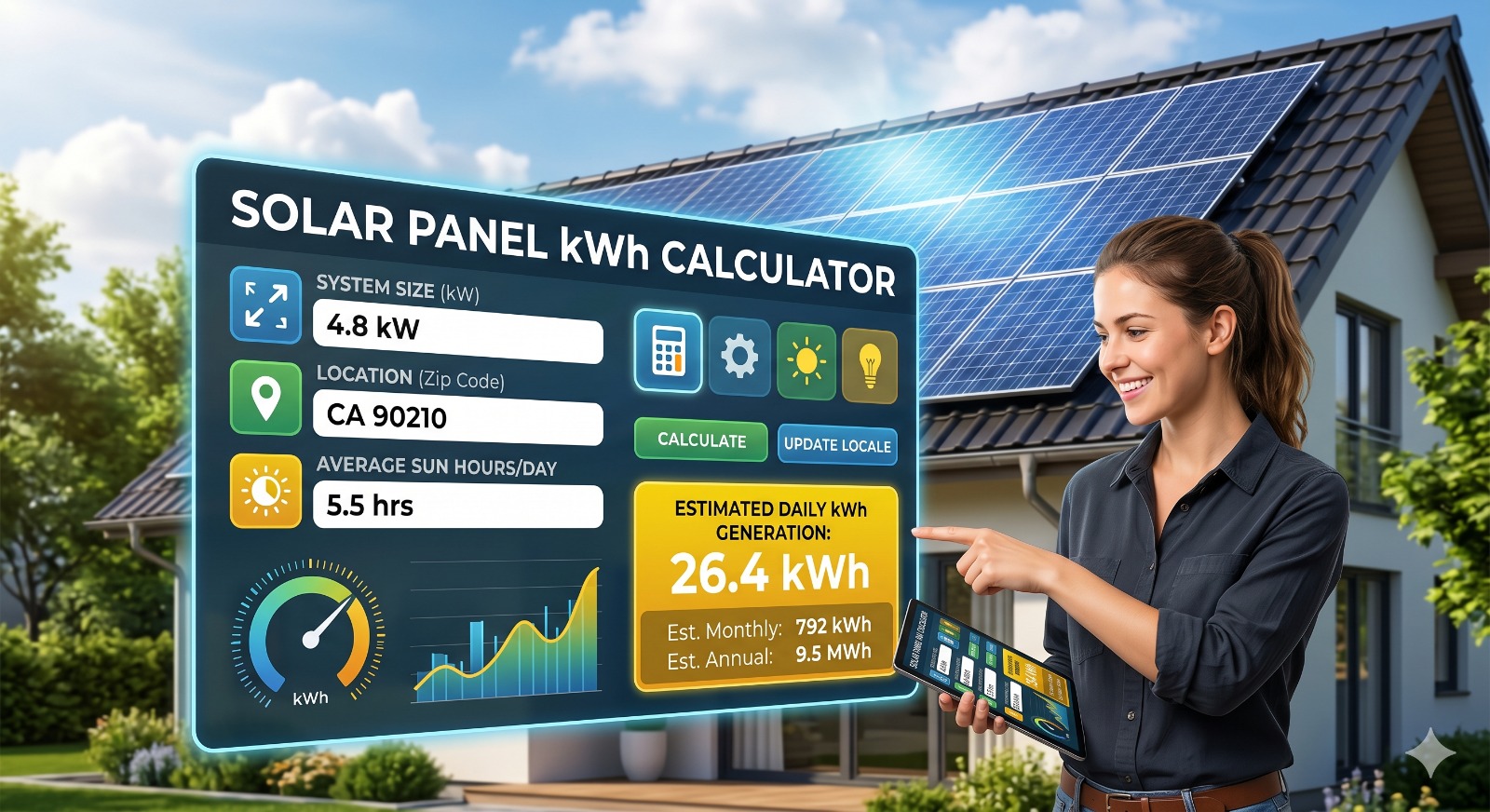
How to Use Solar Panel kWh Calculator
The math behind solar power generation doesn’t have to be a mystery. This tool calculates your expected energy output using the industry-standard formula:System Size (kW) × Peak Sun Hours × System Efficiency = Daily kWh Output
-
System Size: The total wattage of your panels combined, converted to Kilowatts (e.g., ten 400W panels = 4000W, or 4.0 kW).
-
Peak Sun Hours: This is not the total hours the sun is in the sky, but the amount of hours per day your panels receive direct, optimal sunlight (1000 watts per square meter).
-
System Efficiency: Solar panels never operate at 100% capability. Energy is lost through inverter conversion (DC to AC), wiring resistance, dirt on the panels, and heat (panels lose efficiency as they get hotter). The industry standard derate factor is usually between 75% and 85%.
Benefits of Using This Tool Over Others
Unlike standard calculators provided by solar installation companies that use your data as a lead-generation tactic, MyFreeTools offers a pure, unbiased utility.
-
Zero Registration: No email walls or account creation required. Get your math done instantly.
-
100% Private Data: We do not track your location, store your inputs, or capture your IP address to sell to solar vendors. Your calculations stay in your browser.
-
Mobile-First Speed: Designed to load instantly and function perfectly on your smartphone, making it ideal for quick estimates while standing on a roof or talking to a contractor.
-
Adjustable Efficiency: While many tools lock you into a hidden 80% efficiency rate, we allow you to slide the scale based on your specific setup, inverter quality, and shading.
- Finding the sweet spot for your roof's energy potential
- Decoding the math behind a solar panel watt to kwh calculator
- Why regional data beats generic estimates every time
- Key Data Insights for Your Solar Transition
- The hidden drain on your solar panel output calculator kwh results
- Bridging the gap between your utility bill and the sky
- Turning your kwh usage to solar panel calculator figures into a budget
- What features should I look for in a solar panel kWh calculator tool?
Real-world solar planning often feels more like trying to predict the weather with a broken umbrella. You see big promises of zero-dollar bills, but the reality depends on a mix of local utility rates, roof angles, how many times your kids leave the lights on and finally, how much the Sun shows up. So, things are not too easy to calculate, how much energy it can generate.
If you want to move past the guesswork, you can use our dedicated solar panel kWh calculator to get a personalized breakdown of your home’s potential.
Finding the sweet spot for your roof’s energy potential
The first step in any renewable transition is looking at your past to predict your future. You need to pull your last twelve months of utility bills to find your average daily consumption. Most US homes hover around 29 kWh per day, but your specific number determines whether you need twelve panels or thirty.
From the experience of my own Solar panel installation and helping others for many years, I recently helped a homeowner in Phoenix who was shocked that their summer usage tripled compared to their winter bills. This seasonality is why a kwh usage to solar panel calculator is so vital. It helps you size a system for the peaks, not just the averages. Without this data, you risk installing an undersized array that leaves you with a hefty “True-Up” bill at the end of the year.
Utility companies like PG&E or ConEd often provide a CSV download of your hourly usage. Plugging this raw data into an online solar panel kWh estimator for home gives you a much higher degree of confidence than just guessing based on your home’s square footage.
Decoding the math behind a solar panel watt to kwh calculator
A basic solar panel to kwh calculator works by taking the DC rating of your hardware and multiplying it by the peak sun hours in your specific zip code. You then have to subtract for system losses like inverter inefficiency and wiring heat. The math looks complex, but it essentially boils down to: (Total Watts * Sun Hours * 0.8) / 1000.
In my decade of evaluating these systems, I’ve noticed people often confuse “daylight hours” with “peak sun hours.” While the sun might be up for fourteen hours, you might only get five hours of “peak” intensity where the panels hit their full 1000W/m² rating. Most reliable tools use NREL (National Renewable Energy Laboratory) data to pinpoint these exact hours for your city.
Using a solar panel watt to kwh calculator without factoring in your roof’s tilt is a recipe for disappointment. A 30-degree tilt is usually ideal for the middle of the US, but if your roof is flat or very steep, your daily production will dip. A solar panel calculator based on kwh will allow you to toggle these angles to see how they impact your bottom line.
Why regional data beats generic estimates every time
Accurate forecasting requires more than just knowing it is sunny outside. Which online solar panel kWh calculators are most accurate for US households? Look for tools that pull from the PVWatts database or the Global Solar Atlas. These sources account for historical cloud cover, snow days, and even the “albedo effect” where light reflects off the ground.
One client in Seattle was told their roof was useless for solar because of the rain. When we ran their address through a solar panel kwh production calculator, we found that the cool, overcast days actually helped the panels run more efficiently than in the scorching heat of a desert. Over the course of a year, they still cleared 8,000 kWh of production.
Reliable tools should provide a monthly breakdown. You want to see the dip in December and the spike in July. This transparency helps you understand how net metering works in your state, specifically whether you can “bank” summer credits to use during the dark winter months.
Key Data Insights for Your Solar Transition
| Factor | Impact on Efficiency | Source / Context |
| Annual Degradation | 0.5% per year | Standard industry benchmark |
| Federal Tax Credit (ITC) | 30% of total cost | Inflation Reduction Act (valid thru 2032) |
| Average US Monthly Usage | 899 kWh | EIA (Energy Information Administration) 2023 |
| Soiling (Dust/Pollen) | 2% to 7% loss | Varies by rainfall and proximity to roads |
| Shading on one cell | Up to 30% total panel loss | Impact of “bypass diodes” in modern modules |
The hidden drain on your solar panel output calculator kwh results
Even the best hardware faces the law of physics, particularly the “Temperature Coefficient.” As solar cells get hotter, they actually become less efficient at moving electrons. On a 100-degree day in Texas, your panels might produce 15% less power than they would on a crisp, clear 60-degree afternoon.
This is a detail most sales reps gloss over, but a professional solar panel output calculator kwh should include a field for ambient temperature. Modern N-type cells handle heat better than older P-type technology. If you live in the Sun Belt, paying a premium for hardware with a better temperature rating actually saves money over twenty years.
Shading is the other silent killer. A single vent pipe casting a shadow at 2 PM can significantly choke your solar panel kwh per day calculator projections. Micro-inverters or DC optimizers help mitigate this by allowing each panel to work independently, rather than being dragged down by the weakest link in the chain.
Bridging the gap between your utility bill and the sky
To calculate your home’s daily electricity usage in kWh, look for the “Average Daily kWh” section on the second page of your bill. This number is your “target” for the solar array. If your bill says 35 kWh and you want 100% offset, your system needs to be sized to produce that much on average.
I often recommend aiming for 105% to 110% of your current needs. Most homeowners find that once they have “free” power, they start using more of it. Maybe you finally buy that hot tub or switch your gas stove to an induction range. A solar panel power calculator kwh should give you room to grow.
You can also find solar panel kWh calculators that compare different solar brands like Q-Cells, REC, or Maxeon. High-efficiency panels occupy less space, which is critical if your roof is small or has complex geometry.
Turning your kwh usage to solar panel calculator figures into a budget
The final piece of the puzzle is the financial return. A solar panel cost per kwh calculator looks at the total system price after incentives and divides it by the total energy produced over 25 years. Right now, many residential systems are hitting a “Levelized Cost of Energy” (LCOE) of around 6 to 9 cents per kWh.
Compare that to the national grid average of roughly 17 cents. You are essentially pre-purchasing twenty years of power at a 50% discount. Can I calculate potential savings with a solar panel kWh calculator? Yes, provided you factor in the 30% Federal Investment Tax Credit and any local SREC (Solar Renewable Energy Certificate) programs.
Most households see their systems pay for themselves in 7 to 10 years. After that “break-even” point, the electricity is effectively free. It is one of the few home improvements that actually pays you back monthly while increasing the resale value of your property.
What features should I look for in a solar panel kWh calculator tool?
The best free solar power output calculator should be more than just a slider. It needs to ask about your roof orientation (azimuth), your roof pitch, and whether you have obstacles like chimneys. It should also let you compare “String Inverters” versus “Micro-inverters.”
Check if the tool allows for “Battery Storage” modeling. As states move toward “Net Billing” (like NEM 3.0 in California), the value of solar changes. You get less for sending power back to the grid, so storing that energy in a home battery becomes a financial necessity rather than a luxury.
If you are ready to stop looking at averages and start looking at your actual roof, the solar panel kWh calculator on our site is designed to handle these variables. It provides a grounded, realistic estimate that ignores the hype and focuses on the physics of your home.
Companies offering solar energy assessments and quotes often use proprietary software like Aurora or Helioscope. These are great, but having your own independent math from a solar panel kwh production calculator allows you to verify their claims. Never sign a contract until you have run the numbers yourself.
Frequently Asked Questions