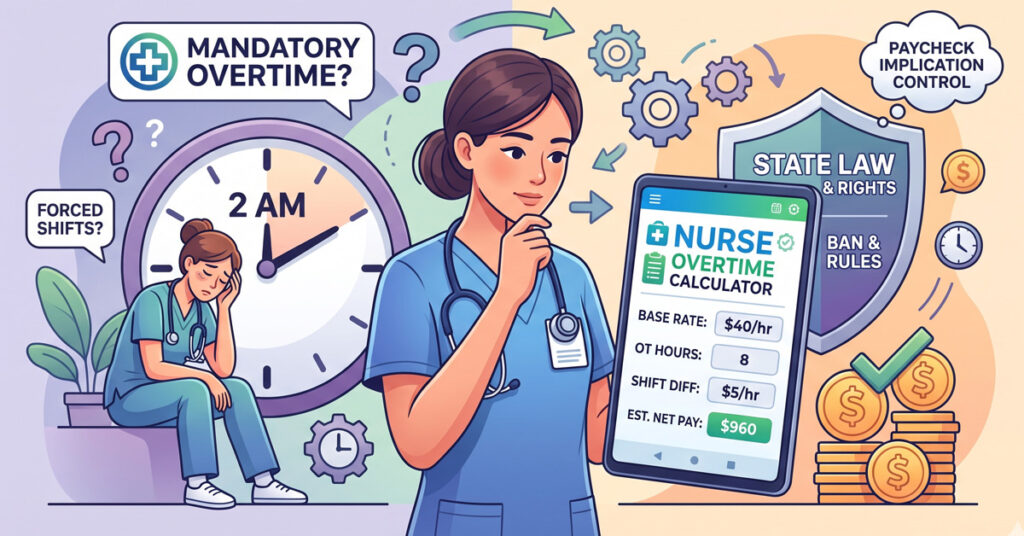
Can a hospital actually force you to work past your shift?
- Key takeaways
- The states where mandatory overtime is capped or banned
- Where the hospital still calls the shots
- Does staying late actually pay off?
- What a nurse overtime calculator is actually doing for you
- When refusing a shift turns into patient abandonment, and when it doesn't
- Your job and your license are not the same fight
- The emergency clause hiding in every state's law
- What happens when the emergency is real
- Why the twelve hour mark is the number that matters
- The federal bill that wants to settle this nationwide
- Travel nurses rarely get stuck working the sixteenth hour
- What a union contract buys you that legislation can't
- The shift differential math nobody walks you through
- Can on call time replace the rest you're owed?
Key takeaways
- You’ll know exactly which legal protections apply where you work, instead of assuming your state follows the same rules as a coworker’s last job.
- Running real numbers through a nurse overtime calculator before you say yes means you’re deciding with your actual take-home pay in front of you, not a gross estimate that looks better than it is.
- Understanding the handoff rule means you can decline an unsafe extra shift without walking into a patient abandonment claim that was never actually a risk.
- Knowing the difference between losing a job and losing a license helps you weigh a forced-overtime standoff without panicking over the wrong consequence.
In most of the country, yes. The Fair Labor Standards Act only controls how you get paid for extra hours, not whether your employer can demand them. That gap is where mandatory overtime lives.
Picture the end of a twelve-hour trauma shift. You’re reaching for your bag. Your charge nurse says you’re not leaving yet.
Federal law guarantees time-and-a-half once you cross 40 hours in a week. It says nothing about a hospital’s right to schedule those hours in the first place. States are the ones who decide whether forced overtime is even legal, and they’re split almost down the middle on it.
Hospitals lean on this tactic because it’s cheaper than hiring. A facility running short three nurses a shift can either post three new positions or just keep extending the staff it already has. Guess which one shows up on next quarter’s budget review.
The states where mandatory overtime is capped or banned
Roughly eighteen states currently restrict or ban forced overtime for nurses outright, a figure cited directly in the congressional record when lawmakers introduced federal legislation on the issue. California, New York, and Alaska are usually the names that come up first.
New York’s rule, Labor Law Section 167, blocks hospitals from requiring overtime beyond a nurse’s regularly scheduled hours except during a declared emergency or an active procedure. The 2023 amendment added real teeth: civil penalties of $1,000 for a first violation, $2,000 for a second within twelve months, and $3,000 for anything after that, according to the New York Department of Labor’s own enforcement page.
Alaska takes a different approach. Facilities there have to file a semiannual report to the Department of Labor and Workforce Development listing every overtime and on-call hour worked, mandatory or voluntary, broken down by nurse.
Michigan almost joined this list. Its Senate passed bills in April 2026 that would ban hospitals from requiring shifts beyond scheduled hours and guarantee eight hours off after a twelve-hour shift, with carve-outs for declared public health emergencies. The bills still need to clear the House.
I find the variation between states genuinely strange. A nurse crossing from New Jersey into Pennsylvania for a per diem shift goes from one legal framework to a completely different one, same license, same patients, different rules about whether she can say no.
Where the hospital still calls the shots
A majority of states have no statute addressing forced overtime for nurses at all. In those places, federal wage law and whatever your facility’s policy says are the only protections you’ve got.
Florida, Texas, and Ohio fall here. So do plenty of others.
This doesn’t mean nurses in these states have zero recourse. It means the recourse is contractual rather than statutory. If your offer letter or union contract doesn’t address mandatory overtime, your hospital’s HR policy is effectively the law that governs you.

A lot of nurses in these states start running their numbers through a nurse overtime calculator before deciding whether to volunteer for an open shift, since there’s no legal cap forcing the math in their favor.
Does staying late actually pay off?
Sometimes. It depends entirely on how many hours you’ve already worked that week, and that’s where the math gets less obvious than people assume.
Cross 40 hours in a week and federal law guarantees time-and-a-half. But a part-time nurse contracted for two twelve-hour shifts who gets pulled into a third only hits 36 hours. Those extra hours pay straight time under federal law, because the weekly total never crossed the threshold that triggers overtime pay.

California changes this entirely for its own nurses. Labor Code Section 510 requires double pay, not time-and-a-half, for any hours worked past twelve in a single day, regardless of the weekly total.
Run a $42-an-hour nurse through that math on a forced sixteen-hour shift in California: regular pay for the first eight hours, time-and-a-half for hours nine through twelve, then double time for the final four. That’s a very different number than the same shift in a state with no daily overtime rule at all.
What a nurse overtime calculator is actually doing for you
It’s translating a messy mix of base pay, multipliers, and differentials into one number you can actually use to decide whether a shift is worth it. Without it, you’re doing fraction math in your head at hour eleven of a shift you didn’t plan for.

Plug in your hourly rate, the extra hours, and any night or weekend differential. The output is your real take-home estimate, not the gross number that looks good until the next tax bracket eats part of it.
I’d rather know the real number before I say yes than find out on payday that the math didn’t work the way I assumed. Open shifts with incentive pay attached are a good example: the bonus looks great until you stack it against what you actually lose in sleep and recovery time.
When refusing a shift turns into patient abandonment, and when it doesn’t
It almost never does, as long as you haven’t taken handoff for the next group of patients. The legal line is the report, not the clock.
State boards of nursing draw a consistent distinction here. A nurse who finishes her scheduled twelve hours and walks away before accepting the incoming patient assignments hasn’t abandoned anyone. The Arizona Nurses Association states this plainly in its own position paper on the subject: declining an assignment after a regular shift ends doesn’t trigger licensure action.
The moment you take that report, the calculation changes. You’ve accepted responsibility for those patients, and leaving without a proper handoff becomes a real problem.
If you’re worried about how a refusal will look later, document it. An Assignment Despite Objection form puts your concerns about fatigue or unsafe staffing on record before anything goes wrong, not after.
Your job and your license are not the same fight
A hospital can fire you for refusing mandatory overtime in an at-will state. The state board of nursing generally can’t touch your license over the same refusal, because employment law and licensure law answer to different authorities.
That distinction matters more than it sounds like it should. Plenty of nurses conflate the two and end up making decisions out of fear of losing their license when the actual risk on the table is losing a specific job.
Losing a job stings. You can find another one. An encumbered license follows you to every employer in the state, which is why most nurses I’ve talked to treat the two risks very differently even when their hospital’s HR department wants them to feel equally scared of both.
The emergency clause hiding in every state’s law
Every state, even the strictest ones, suspends its normal overtime rules during a declared emergency. The protections that exist on a normal Tuesday don’t survive a hurricane, a mass casualty event, or a governor’s emergency declaration.

New York’s own statute spells out the limits on this exception clearly: an unanticipated staffing emergency has to be something that genuinely couldn’t have been planned for. A hospital that simply failed to schedule enough coverage for flu season doesn’t get to call that a qualifying emergency just because it’s inconvenient.
That distinction is the whole ballgame. Real disasters suspend the rules. Chronic understaffing dressed up as a crisis does not, at least not legally.
What happens when the emergency is real
Normal staffing math disappears the moment a hospital is actually overwhelmed. A multi-vehicle pileup, a building collapse, a sudden disease outbreak, any of these can trigger the emergency exception nearly every state carves into its overtime law.
During an actual hurricane, the rules everyone debates the rest of the year stop mattering. You stay because the alternative is an empty floor, not because anyone’s checking a box on a compliance form.
Once the declared emergency ends, the normal rules come back immediately. A facility can’t keep citing last month’s storm to justify this month’s short-staffed Tuesday.
Why the twelve hour mark is the number that matters
Cognitive performance doesn’t degrade gradually as a shift goes on. It tends to fall off a cliff somewhere past hour twelve, and the data on medication errors backs that up directly.
Research compiled by the American Association of Nurse Anesthesiology found nurses making roughly double the medication errors in shifts running past 12.5 hours compared to shorter ones. The ANA’s own position statement on nurse fatigue draws the same conclusion: extended and irregular hours disrupt sleep cycles in ways that show up later as missed dosages and overlooked changes in a patient’s condition.
This is the data point that drove Michigan’s recent legislative push. Lawmakers there pointed directly to the link between exhaustion and avoidable errors as the reason for capping shifts at twelve hours with mandatory rest after.
I’ll be honest, the industry’s relationship to this fact is uncomfortable. Everyone in healthcare knows fatigue causes errors. Fixing it costs money the hospital would rather not spend on additional hires.
The federal bill that wants to settle this nationwide
The Nurse Overtime and Patient Safety Act would tie a hospital’s Medicare participation directly to limits on mandatory overtime, which is about as sharp a financial incentive as Congress can hand a hospital system. The bill’s actual text, filed as S.3860 in the prior Congress, amends the Social Security Act to make compliance a condition of receiving Medicare payments at all.

The American Nurses Association has pushed hard for this, framing it the way the trucking and aviation industries already treat hours-of-service limits: as a basic safety floor, not a luxury. As of the ANA’s most recent congressional priorities letter, the organization is still urging lawmakers to revive and pass the bill.
Hospital lobbying groups have pushed back consistently, and federal healthcare legislation moves slowly even when nobody’s actively opposing it. Until something passes, the patchwork of eighteen-ish state laws and one federal wage rule is what nurses are working with.
Travel nurses rarely get stuck working the sixteenth hour
Travel contracts spell out maximum weekly hours in advance, and agencies enforce those terms aggressively because the premium rate they’re charging makes forced overtime expensive for the hospital in a way core staff overtime isn’t.
A hospital short-staffed at 7pm will almost always pressure a permanent employee before touching a travel nurse’s contracted hours. The travel rate can run two to three times what a staff nurse costs per hour, so forcing that nurse to stay erases a chunk of the savings the hospital was counting on from using travelers in the first place.
This creates real friction on the floor. Core staff watching a traveler clock out on time while they’re starting hour fourteen isn’t an abstract resentment, it’s a daily one.
What a union contract buys you that legislation can’t
A collective bargaining agreement takes effect the moment it’s signed. State legislation, even when it eventually passes, can take years working through committees first.
Unionized facilities typically require management to exhaust a specific list before mandating anyone stay: posted volunteer sign-ups, per diem callouts, incentive pay offers. Only after all of that fails does forced overtime become an option, and even then it has to follow whatever sequence the contract spells out.
In states with no statutory protection at all, this is often the strongest lever available. I’ve seen union reps shut down an illegal mandate on the spot, citing contract language a hospital administrator clearly hadn’t read closely.
The shift differential math nobody walks you through
Night and weekend differentials stack on top of base pay even when the hours are forced rather than chosen, which means a single bad night can involve three separate pay rates layered on top of each other.
Say you normally work days and get pulled into an unplanned night shift. You’re now earning your base rate, a time-and-a-half multiplier on the overtime portion, and a separate night differential, all calculated on different slices of the same four-hour block. A nurse overtime calculator earns its keep here, because doing this by hand at 2am after twelve hours on your feet is asking for an error.
Check your actual pay stub against what you expected. Facilities sometimes apply the wrong differential code when a shift starts during the day and runs into the night, and that mistake doesn’t always get caught unless someone’s looking for it.
Can on call time replace the rest you’re owed?
No, not in the states that regulate this, and the rule is explicit rather than implied. On-call time doesn’t count as rest, because you’re still tethered to your phone and unable to actually disconnect

New York’s Department of Labor states this directly: employers may not substitute on-call time for mandatory overtime, full stop. Pennsylvania’s Act 102 contains nearly identical language, built into the statute itself, specifically to stop facilities from circumventing the rest requirement by relabeling it.
The logic holds up. Being available to respond at any moment is its own kind of work, even if you’re technically off the clock. A hospital sending someone home but expecting their phone on isn’t offering rest, it’s offering a shorter leash.

Quality & Expertise Assurance

Nancy
Nancy has 3 years of experience in Nursing and Medicare in the USA. She enjoys sharing healthcare insights, patient care experiences, and practical wellness tips, and has also contributed as a columnist for healthcare magazines.

Geeta Arora
Geeta Arora has 3 years of experience covering the USA real estate market and 2 years writing about solar energy, focusing on industry trends, homeownership insights, renewable technology, and practical energy solutions for everyday readers.